
Once you know a few basic chords, the next step is learning how they fit together. That’s where piano chords and progressions come in. A progression is simply a sequence of chords played one after another, and a small number of them turn up again and again in pop, rock, folk, hymns, ballads and film music. Learn those few patterns well and you’ll find you can play along with a surprising number of songs.
In this guide I’ll explain how progressions work in plain language, show you the easy patterns worth learning first (all in the key of C, so there are no black keys to worry about at the start), and give you practice tips for changing chords smoothly.
A quick refresher: what is a chord?
A chord is three or more notes played together. The chords you’ll use most as a beginner are triads: three notes built by stacking every other white key.
- C major: C, E, G
- F major: F, A, C
- G major: G, B, D
- A minor: A, C, E
If you haven’t learned to build these yet, start with my guide on how to learn piano chords, which explains the simple step patterns behind major and minor chords. Then come back here to put them into progressions.
How piano chords and progressions work
Every key has a family of chords that sound natural together. In the key of C major, you can build a chord on each note of the C major scale using only white keys:
| Scale note | Chord | Type | Roman numeral |
|---|---|---|---|
| C | C (C–E–G) | Major | I |
| D | Dm (D–F–A) | Minor | ii |
| E | Em (E–G–B) | Minor | iii |
| F | F (F–A–C) | Major | IV |
| G | G (G–B–D) | Major | V |
| A | Am (A–C–E) | Minor | vi |
| B | Bdim (B–D–F) | Diminished | vii° |
Musicians use Roman numerals to describe progressions so they work in any key. Upper case means major and lower case means minor. So “I–IV–V” in C means C, F and G. In the key of G, the same pattern would be G, C and D.
You don’t need to memorise all of this today. The important idea is that a handful of numbered patterns describe a huge amount of music. If the scale part feels unfamiliar, my guide to piano scales for beginners shows where these notes come from.
Six easy piano chord progressions for beginners
Play each progression with the chord in your right hand and the root note (the chord’s name) in your left. Give each chord four slow, steady beats.
1. I–IV–V–I (C – F – G – C)
This is the foundation of countless folk, country, blues and early rock songs. It sounds complete and settled because it ends where it started. If you only learn one progression, make it this one.
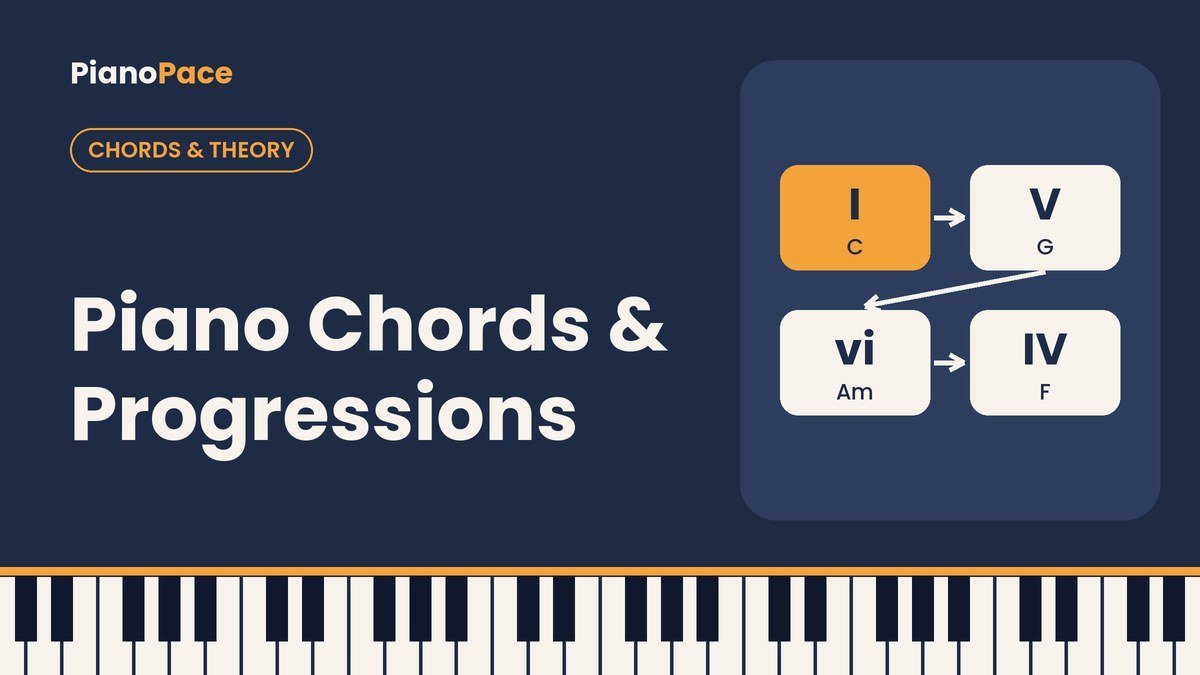
2. I–V–vi–IV (C – G – Am – F)
You’ll recognise this sound immediately. It’s used in a great many modern pop songs and ballads. Try playing it round and round, and you’ll probably hear several songs you know.
3. vi–IV–I–V (Am – F – C – G)
This uses the same four chords as the previous progression, just starting on A minor. Beginning on the minor chord gives it a more emotional, wistful feel.
4. I–vi–IV–V (C – Am – F – G)
Often linked with 1950s doo-wop, this progression has a warm, nostalgic quality. It’s also lovely played slowly as a gentle ballad.
5. ii–V–I (Dm – G – C)
This short progression is at the heart of jazz harmony, and it turns up in many other styles too. It creates a strong sense of “coming home” when you reach the C chord.
6. The 12-bar blues (C – F – G)
The classic 12-bar blues uses just three chords, arranged over twelve bars:
| Bars 1–4 | Bars 5–8 | Bars 9–12 |
|---|---|---|
| C – C – C – C | F – F – C – C | G – F – C – C |
Play each chord for one bar of four beats. Once it feels comfortable, try a swung rhythm for a bluesier sound.
How to change chords smoothly with inversions
When beginners first play progressions, they often jump their whole hand up and down the keyboard, which sounds choppy. The fix is to use inversions: the same three notes rearranged so your hand barely moves.
Here’s I–IV–V–I in C using close positions:
| Chord | Notes (bottom to top) | What moves |
|---|---|---|
| C | C – E – G | Starting position |
| F | C – F – A | C stays; E moves up to F, G moves up to A |
| G | B – D – G | Thumb moves down to B, middle finger to D, top finger to G |
| C | C – E – G | Back home |
Notice how notes are shared or move by just a step. The music sounds smoother, and your hand stays in roughly the same place. For I–V–vi–IV, try C (C–E–G), G (B–D–G), Am (C–E–A) and F (C–F–A). Again, very little movement.
Simple left-hand patterns to try
Once your right hand is comfortable, give your left hand more to do. Try these in order of difficulty:
- Single root notes: play the chord’s name note, held for four beats.
- Root on beats one and three: play the root note twice per bar for a steady pulse.
- Root and fifth: alternate the root with the fifth note above it, counting the root as one (for C, play C then G).
- Octaves: play the root note with your thumb and little finger an octave apart.
- Broken chords: play the left-hand chord one note at a time, low to high.
Keep the right hand on simple held chords while you learn each new left-hand pattern. Adding both at once is where most beginners get tangled.
Moving progressions into other keys
Because progressions are described with numbers, you can move them into other keys. Here are the same four chords of I–V–vi–IV in two other beginner-friendly keys:
| Key | I | V | vi | IV |
|---|---|---|---|---|
| C major | C | G | Am | F |
| G major | G | D | Em | C |
| F major | F | C | Dm | B♭ |
G major introduces F♯ inside the D chord, and F major introduces B♭. These are good first steps towards playing in keys with black keys.
How to practise chord progressions
A short, focused routine works best. Try this ten-minute plan:
- Two minutes: play each chord in the progression on its own, saying its name out loud.
- Three minutes: play the progression slowly with right-hand chords only, four beats per chord.
- Three minutes: add the left-hand root notes.
- Two minutes: play along with a simple song that uses the progression, or loop the progression and hum a melody over it.
Use a metronome at a slow tempo. Aim for no pauses between chords, even if that means going slower. A steady, slow progression sounds far more musical than a fast, hesitant one.
Using progressions to play real songs
The real reward comes when you notice progressions in the music you already love. Many beginner-friendly songs use the chords above. My list of easy songs to learn on piano includes simple chord symbols you can practise with.
Progressions are also the key to playing by ear. Once you know the common patterns, you start to recognise them when you hear them. If that appeals to you, my guides on how to play piano by ear and how to play piano by ear using chords show you how to work out songs by listening.
You’ll find more guides to harmony and theory in the Chords & Theory section.
Frequently asked questions
What is the most common chord progression?
I–V–vi–IV (C–G–Am–F in the key of C) and I–IV–V–I (C–F–G–C) are two of the most widely used progressions in popular music. Learning both gives you a strong foundation.
How many chords do I need to know to play songs?
Many songs use just three or four chords. If you know C, F, G and A minor, you can play a large number of simple songs in the key of C.
What do the Roman numerals in chord progressions mean?
They show which note of the scale each chord is built on. I is the first note, IV the fourth, V the fifth, and so on. Upper case means major and lower case means minor. This lets you play the same progression in any key.
How long does it take to learn chord progressions?
Most beginners can play a simple progression slowly within a few practice sessions. Changing chords smoothly and in time usually takes a few weeks of short daily practice.
Final thoughts
Learning piano chords and progressions is one of the fastest ways to make the piano feel musical. Start with I–IV–V–I and I–V–vi–IV in C, use inversions to keep your hand still, and practise slowly with a steady beat. Before long, you’ll start hearing these patterns everywhere, and that’s when the keyboard really begins to open up.